The Arizona bark scorpion is the only species in the American Southwest capable of scaling vertical masonry walls, smooth stucco, and residential interior drywall. In Scottsdale foothill communities like Troon North,…
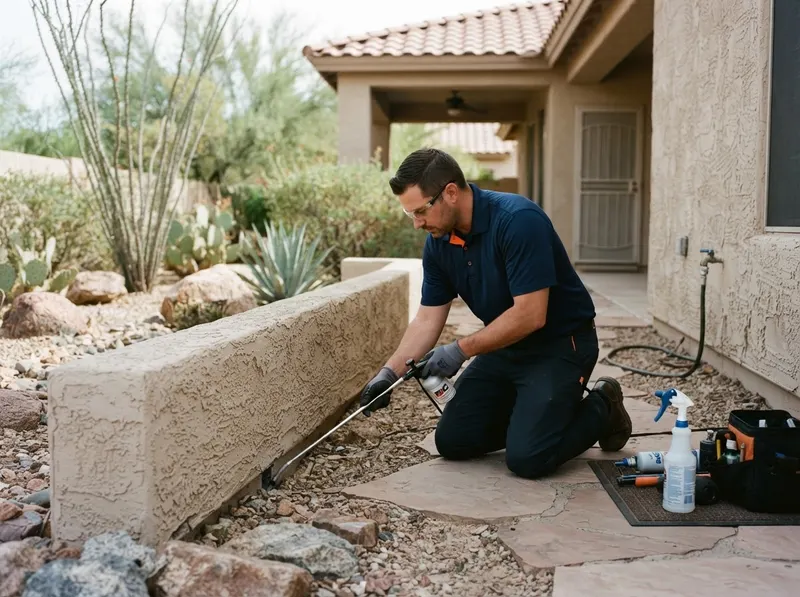
The Arizona bark scorpion is the only species in the American Southwest capable of scaling vertical masonry walls, smooth stucco, and residential interior drywall. In Scottsdale foothill communities like Troon North, Silverleaf, and Desert Mountain, scorpion activity surges between May and October when Sonoran ground temperatures surpass 100 degrees Fahrenheit, driving scorpions through exterior weep screeds into baseboards, shoe closets, and master bedrooms. Standard pest spraying coats open surfaces with repellent pyrethroids that scatter scorpions deeper into wall voids rather than neutralizing the harborage. Professional scorpion defense relies on structural exclusion: sealing the foundation weep screed using stainless steel micro-mesh that maintains required foundation ventilation while blocking access points as narrow as 1.5 millimeters, the thickness of a credit card.
Decision-fit guidance centers on infestation location and immediate risk level. If scorpions are detected exclusively outside around block wall boundaries near McDowell Sonoran Preserve or Pinnacle Peak Park, an exterior perimeter micro-encapsulated treatment coupled with xeriscape harborage elimination secures the perimeter. If specimens appear on interior ceilings, bathroom tile, or nursery carpets in established golf course properties like Gainey Ranch or McCormick Ranch, structural physical exclusion becomes necessary. The operational trade-off of full physical exclusion is upfront capital commitment versus long-term security; physical exclusion requires meticulous exterior caulk and mesh work around air conditioning line sets, exterior hose bibbs, and stucco expansion joints, yet it resolves the entry vulnerability permanently without trapping occupants in endless, recurring monthly spray cycles.
Effective defense requires understanding the operational limits of scorpion biology. Bark scorpions absorb insecticides through tiny sensory structures called pectines on their ventral abdomen; therefore, standard fine-mist sprays fail because the arachnid's heavy chitinous exoskeleton shields vital organs. Specialized water-resistant, micro-encapsulated applications cling to passing scorpions, allowing the active ingredient to transfer grooming residues safely outside living quarters. Technicians working from South Scottsdale to DC Ranch and Grayhawk identify primary desert harborages, such as dead palm fronds, stacked flagstone, and unsealed expansion joints around pool decks near Salt River Fields, neutralizing the prey base to ensure durable protection for vulnerable children and pets.
Every job gets a firm, written price after a free on-site visit.
Tell us about your bark scorpion control & exclusion job in Scottsdale and we'll send a clear, written quote, usually the same day.
 Desert Finch Pest Control