In Maricopa County, the native desert subterranean termite poses a silent threat to residences across McCormick Ranch and Gainey Ranch, where mature landscaping pairs with classic slab-on-grade architecture. These…
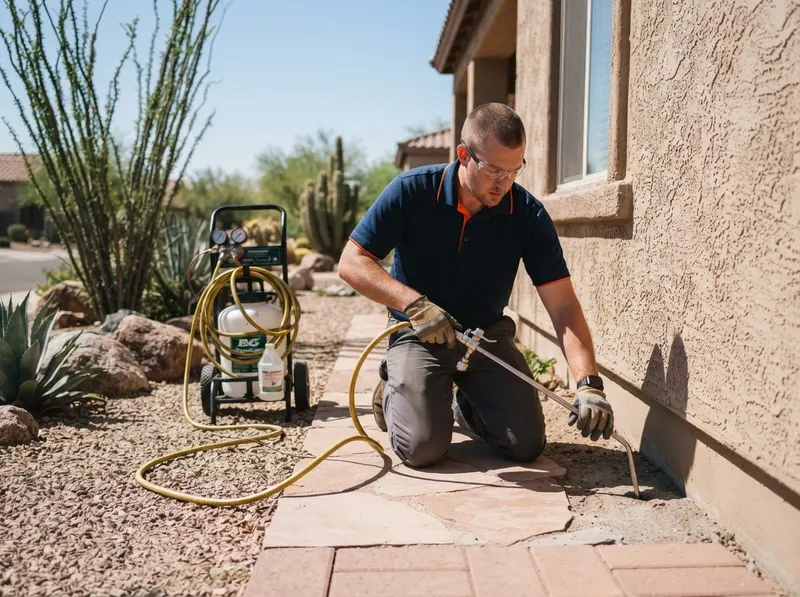
In Maricopa County, the native desert subterranean termite poses a silent threat to residences across McCormick Ranch and Gainey Ranch, where mature landscaping pairs with classic slab-on-grade architecture. These colonies live deep within caliche-heavy soils to escape summer surface temperatures that exceed 115 degrees Fahrenheit. Workers construct subterranean mud tubes through hairline foundation cracks, plumbing penetrations, and behind exterior stucco weep screeds, feeding on internal drywall paper and wall studs long before exterior evidence appears. Unlike drywood termites that live entirely inside exposed framing, subterranean colonies require continuous soil moisture access to survive, making continuous soil barrier integration mandatory rather than simple topical sprays.
Protecting desert xeriscaping while safeguarding children and companion animals guides the application protocol. Precision trenching involves opening a narrow 6-inch by 6-inch trench directly against exterior stem walls, applying an undetectable non-repellent formulation that foraging worker termites track back to the subterranean reproductive nest. When concrete patios, flagstone walkways, or garage slabs directly abut the exterior frame in communities like DC Ranch or Troon North, technicians drill 1/2-inch ports through the concrete every 12 inches to inject the termiticide directly into the underlying sub-slab soil, immediately sealing each port with matching hydraulic cement. This methodology preserves native agave, saguaro, and sensitive pet turf yards because the material binds tightly to sub-surface soil particles without leaching into irrigation zones or evaporating into living areas.
Property owners must evaluate full perimeter liquid barriers versus localized spot interventions. If a mud tube surfaces on an interior drywall seam in a single room, a localized foam injection addresses the active foraging gallery immediately, but leaves the remaining perimeter unprotected against satellite colonies navigating the same slab foundation. If long-term structural security is required, a comprehensive perimeter liquid barrier provides an uninterrupted chemical zone around every linear foot of the foundation. The trade-off centers on upfront scope versus residual risk: localized treatments minimize immediate expense, whereas full-perimeter soil installations require physical drilling through abutting masonry patios yet establish a durable shield against hidden colony expansion.
Every job gets a firm, written price after a free on-site visit.
Tell us about your subterranean termite treatment job in Scottsdale and we'll send a clear, written quote, usually the same day.
 Desert Finch Pest Control